Showing posts with label Indian defence. Show all posts

May 25, 2011

India does not need a blue water navy

.
.
.
.
Yes I write these posts from time to time repeating the same points or there abouts.

India does not need a Blue water navy. What ever the dictates of the RSS at Pune, and their silly Israeli funded unrealistic ambitions.

India needs to develop FIRST and foremost strong reliable strategic relationships with her immediate neighbor countries.....such as Pakistan, Nepal, Bangladesh, Sri Lanka, Afghanistan and China. Save China, India can buy better relations with these nations through regular AID, and greater trade .........a recent 20th century foreign policy phenomenon most famously executed by the USA since WWII, and China since the 1990's.

SECOND, India has fought all its wars on LAND comprehensively, with the sea playing a negligible peripheral side show theater: 1948, 1962, 1965, 1971, 1999.

The military top brass think the next war will be on land....90% sure. I am 100% sure the next war will be on land. Therefore military procurement expenditure should be 70% army; 25% airforce and about 5% navy. The paltry defense budget/expenditure should be pooled so that it is spent where it is most needed. Granted that the navy always needs to be upgraded with new equipment, but the priority must be the army.

India will never be a superpower......it is a tropically hot country, with mainly tropically hot people.....save for the 15-20% Aryans, who migrated South from the Pontic Steppes/Central Asia 3500 years and onwards. India may have been a superpower under Ashok in the 3rd century BC, and under Akbar in the 16th century.....but never in the modern sense.

I would like India to decisively ditch any notions and pretensions of being a super power. Being a superpower is dangerous and self destructive...as we saw with the Soviet Union and the USA now. India should focus on meeting the basic needs of its people first and foremost.....thats it. Its a big enough challenge for the post-colonial Macaulay Brown Sahib corrupt neo-liberal International banker governments of the Congress and BJP.


Manekshaw the Great
sipāhī---Persian word meaning soldier.
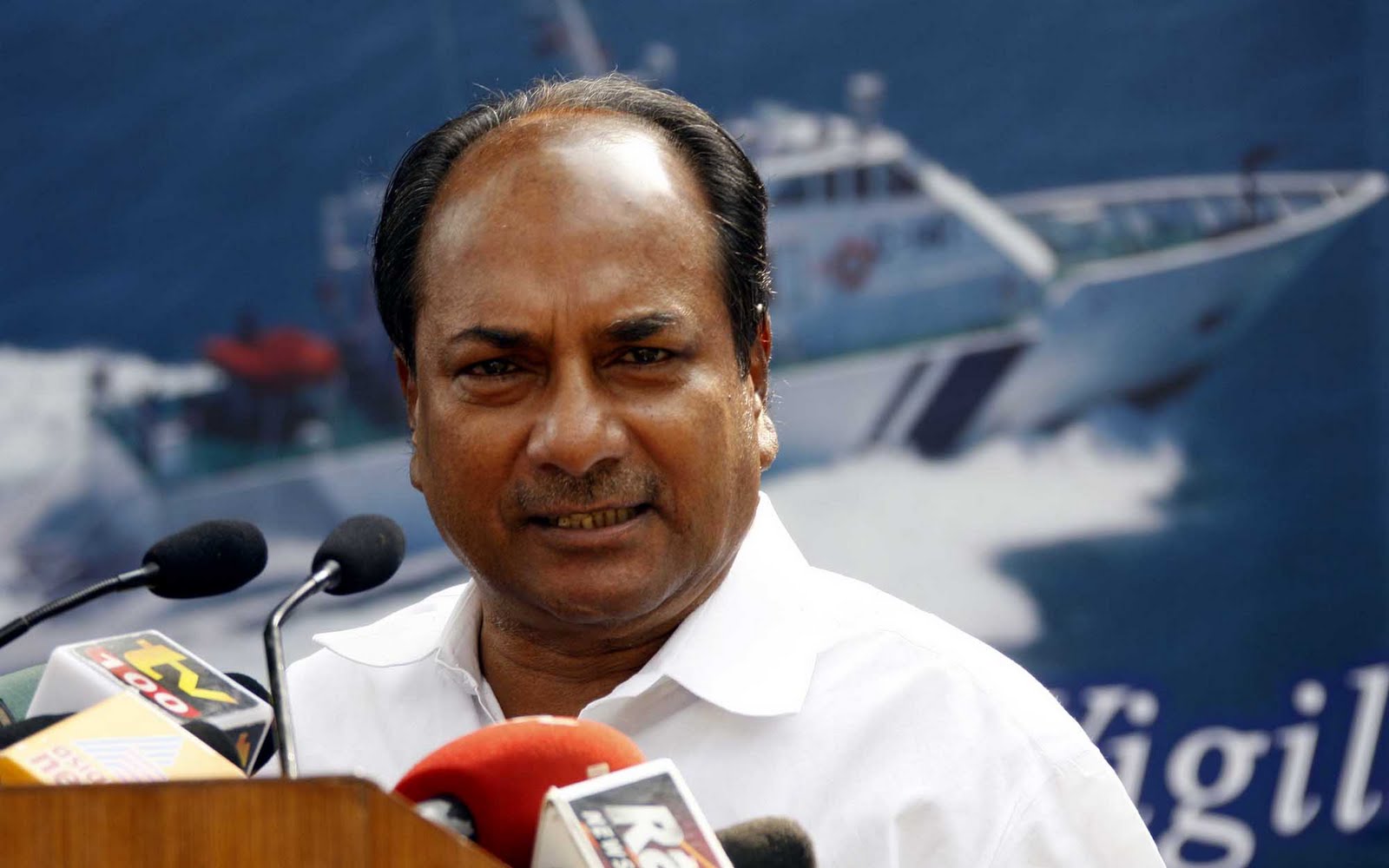


AK 47 Anthony the Harijan convert with his boats......recruited by Western Intelligence. Suppressing Indian indigenous defense production in favor of Red Herring foreign procurements from around the world (70-80% of all arms procurements annually....63 years after "independence") which gives his MoD mafia contractors (netas, babus, officers) huge kickbacks....but leaves India's strategic defense vulnerable.

Pakistan's arms and ammunition industry, with an economy 8 times smaller, produces better and more reliable defense equipment simply because the Pakistani military cannot afford to buy abroad, its cheaper to produce domestically......so why can't India? Because of the conspiracy of the Defense mafia within the MoD of India.

100% of American arms procurement is domestic.

98% of Russia's arms procurement is domestic.

98% of China's arms procurement is domestic.

20% of India's arms procurement is domestic......and even then given the level of foreign parts its questionable whether even the 20% are really domestic productions.

If you have false misdirected ambitions of being a "great power"....at a minimum first of all try producing your own arms........you can't be a "great power" using other nations "great mix" of arms and spares.

___________________________

India to boost 'blue-water' warfare punch with two new stealth frigates

Rajat Pandit of the TOI.


The Navy continues to hone its war-fighting capabilities despite being stretched in coastal security and anti-piracy operations. The force is now on course to soon induct two more deadly stealth frigates to bolster its growing "blue-water" warfare capabilities.

Sources say the 6,200-tonne indigenous stealth frigate INS Satpura is likely to be commissioned in June-July, while the Russian-built 4,900-tonne INS Teg should finally be ready for induction by September-October.

These long-awaited warships will come at a time when Navy chief Admiral Nirmal Verma has stressed that "maintenance of war-fighting abilities" remains the "top-most priority" for his force despite the "large number of peacetime commitments (anti-piracy, coastal security and the like) at hand".

"With the security situation being fluid, we need to maintain the organizational ability to deploy warships, submarines and aircraft at immediate notice," said Admiral Verma, at the naval commanders' conference here on Tuesday.

INS Satpura and INS Teg will certainly boost combat capabilities, packed as they are with sensors, weapons and missile systems, coupled with their stealthy nature due to "vastly-reduced" radar, infra-red, noise, frequency and magnetic "signatures" to beat enemy detection systems.

That's not all. INS Satpura, the second of three indigenous stealth frigates built under the Rs 8,101-crore Project-17 at Mazagon Docks, will be followed by INS Sahyadri after six months. The first, INS Shivalik, was commissioned in April last year.

Similarly, INS Teg is to be followed by its sister frigates, INS Tarkash and INS Trikhand, built under a Rs 5,514-crore project inked with Russia in July 2006, after gaps of six months each.

Both the Indian and Russian projects, of course, have been dogged by huge time and cost overruns. The three warships from Russia are actually "a follow-on order" to the first three frigates, INS Talwar, INS Trishul and INS Tabar, inducted by India in 2003-2004 at a cost of over Rs 3,000 crore.

Though their induction too was delayed, the Navy is quite happy with the power the Talwar-class frigates pack. The warships have "a very high weapon and sensor density", including eight vertical launch cells for the 'Klub-N' anti-ship and anti-submarine cruise missiles. In addition, the three new frigates will also be armed with the 290-km BrahMos supersonic cruise missiles.

The Shivalik-class frigates, in turn, can also deal with "multiple-threats" in all three dimensions -- air, surface and sub-surface. Apart from Russian Shtil surface-to-air missile systems and Klub anti-ship cruise missiles, they are also armed with the Israeli 'Barak-I' anti-missile defence systems to guard against Harpoon and Exocet missiles, launched from platforms like P-3C Orion aircraft and Agosta-90B submarines which Pakistan has acquired from US and France.

The defence ministry has also approved Project-17A to construct seven more frigates at Mazagon Docks and GRSE in Kolkata, with even more stealth features, for around Rs 45,000 crore. In all, the Navy has around 30 new warships and six submarines on order as of now to maintain its force-levels at about 140 combatants.

Dec 22, 2010

Russia India cooperation.

.
.
.
.
Russia is in Europe, Russia is in Asia....obviously naturally Russia must maintain good relations with Asian countries. For the last 400 years, the main security threat to Russia has come from the West......save for the brief Japanese debacle in 1904-5, which were soundly repaid in 1938, and 1945.

_______________________

5G deal makes Russia No. 1 defence partner by a long shot

Rajat Pandit of the Times of India.

Move over Israel, France, the UK and the US, Russia has reasserted its numero uno status in the lucrative Indian defence market. The Soviet era's heady romance of "friendship prices" and "sweet deals" may be long dead and gone, but the long-standing strategic clinch shows no sign of abating. The expansive Indo-Russian defence partnership, which has already zoomed past $35 billion since the 1960s, marked a new high on Tuesday with the two nations inking the preliminary design contract (PDC) for joint development of the fifth-generation fighter aircraft (FGFA).

The PDC may be only worth $295 million but it will, as earlier reported by TOI, lead to India spending around $35 billion over the next two decades to induct between 250 and 300 of advanced stealth fighters from 2020 onwards in what will be its biggest-ever defence project. The Indian FGFA or "perspective multi-role fighter" will be based on the Russian single-seater FGFA called Sukhoi T-50, a prototype of which is already flying, but will be tailored to the IAF requirements. The IAF wants a twin-seater FGFA powered by a new engine "with a higher thrust". India and Russia, incidentally, will market the FGFA to "friendly third" countries at a later stage.

India will keep its fingers crossed because of the Russian propensity to miss delivery schedules, jack up costs mid-way through execution of agreements and create roadblocks in transfer of technology. The failure to provide uninterrupted supply of spares or regular maintenance has been another major sore point for India.

For instance, the prolonged and bitter dispute over aircraft carrier Admiral Gorshkov's refit cost had even led the then Navy chief Admiral Sureesh Mehta to publicly warn that India should not put "all its defence eggs in the Russian basket".

(Equally pointless Sureesh Mehta saab having 10 different jet fighters from several different countries all requiring a variety of spares and refits.....ditto naval equipment,..... ditto army equipment. The key is technology transfers and domestic production, and it would seem Russia is the most generous in this area )

India has consciously diversified its defence imports since the 1999 Kargil conflict, turning towards countries like Israel, France, UK and now increasingly the US. Israel, in particular, is snapping at the heels of Russia, notching up sales worth over $10 billion since Kargil.

But Russia still remains — and will be so in the foreseeable future — India's largest defence partner. Gorshkov will now come only in early-2013 — earlier it was slated to be delivered in August, 2008 — with India paying $2.33 billion instead of the earlier $974 million in what was thought to be 'a fixed price contract' when it was inked in January 2004.

India realizes only Russia will be ready to supply it with some "sensitive" military hardware (Yesss...penny has dropped). By May-June next year, the country will get the K-152 Nerpa Akula-II nuclear-powered submarine from Russia on a 10-year lease as part of a secretive 2004 deal.

_______________________________

ONLY THE SOVIET UNION built up India's strategic muscle....steel mills, power stations, machine tools factories, and so forth ORIGINALLY from the 1950's........only after the Soviets stepped in to help did others offer....notably the UK, and West Germany with strategic industries........Strategic industries are what gives nations real power.

Dec 10, 2010

The wrong theater.

.
.
.
.
As per "Cold Start" and actual experience in 1948, 1962, 1965, 1971, 1999 .......and zillions of border skirmishes suggest the real action is on LAND, and more specifically up the mountains.

Submarines and the navy generally since 1947 have seen little or no action, and a quick gaze at the Crystal Ball seems to confirm that they are not likely to see any action in the future either, save as serving as some kind of dubious mascot of India's arrival in the Super Power League status scene. Rather like the last Czar of Imperial Russia spending well over 50% of his military budget on the strategically unimportant navy with its 91,000 personnel, and wholly neglecting the far more important army of 1,200,000.

It is only when the Russian imperial army ill-equipped with poor logistics and supplies suffered devastating losses in 1916, that the Czarist regime collapsed a year later.......THE DEFEAT OF THE ARMY WAS A CATALYST FOR THE HORRIFIC JEWISH BOLSHEVIK REVOLUTION SUBSEQUENTLY WHICH EVENTUALLY CLAIMED THE LIVES OF 60 MILLION SOVIETS FROM 1918--1991.


India has been tested by Pakistan, which has one of the worst military's in the world, and India has done reasonably well against them in easy two week spats. But it is ironical that India should now buy over priced hardware from Russia and many other countries instead of investing in domestic production, and focusing greater resources in the army. A C-130 should normally cost about $60 million per plane not $350 million each. Its a very old plane based on a German WWII design, produced since the 1950's. A very simple old plane which should have a simple low price.

However obviously in corrupt Macaulay Brown Sahib India as per the previous copy paste, defense procurement is not PRIMARILY about strategic national requirements but about which babus and netas can make the most money from kick-backs from foreign countries, hence the decades long periods of "tendering" "haggling" from foreign buyers for every major items of purchase. Its a Mela and a ritualized event........the result means:

1) India's arms inventory is 70-80% foreign imported. The USA, China's and Russia's arms inventories are 100% domestic manufactured and designed. To be a reasonably serious POWER India must COPY the USA, China and Russia's policy and investment on domestic production and design only. The remaining arms inventory of India, where domestic production is concerned many of the spares have foreign components........Arjun tank, Tejas planes; so not really domestic in the 100% sense. You cannot fight mass warfare for long periods by relying on a MERE 39 ordnance factories, and foreign suppliers for spares. You cannot do a Nehru in the 1960's begging foreign countries to provide arms and help of whatever shape, and they subsequently don't.....you logically manufacture your own arms....standard or substandard. The T-34 tank was not standard, it had many faults when introduced by the Soviets in 1940, but eventually the problems were ironed out. But the Indian military/babus corrupt complex want PERFECT....WORLD CLASS weapons systems from the get go from DORDO....which of course they can't, deliver.

2) This foreign tendering and purchase means India has a complex mishmash of wholly irrelevant arms from various sources. India has too many different combat planes, tanks and artillery. Useless......unless you want to open a museum.

3) India needs to bolster her ordnance capacity from the current mere 39 factories to about 300--500 actual ordnance factories, and about 10,000 defense related factories employing a few million people....3-5 million. A complete ban on foreign purchases, and greater defense expenditure should meet such targets.

4) India needs to permanently maintain about 700---800,000 men in Kashmir; 200,000 Himachal Pradesh/Uttarakhand; 300,000 men in Arunchal Pradesh; 500,000 Assam; 600,000 near Pakistan in the Punjab, Rajasthan and Gujarat and about 200,000 in other parts of India.......with 2,400,000 regular reserves. Since the Indian military lacks proper logistics, and good infrastructure it makes sense to follow the Rommel doctrine of keeping men in the "VICINITY" of likely future flash points of war. Rommel realized with the experience of fighting 4 years that his sector B lacked proper air-cover with just 550 planes of which 400 were serviceable in the entire Western sector in June 1944(France and the Low countries), and of course poor logistics......3/4 pounds of ration for each German soldier in comparison to 30 pounds daily ration for British troops and 40 pounds daily ration for American troops....limited ammunition, and very limited transports. So instead of wasting time moving men around the battle theater in such a hostile situation he preferred to station his best units, and about 4/5 panzer divisions of the 10 in France near the beaches of Normandy, where he speculated the action could be under his command, besides building formidable, if incomplete defensive systems (In light and and in anticipation of the weaknesses of his forces)........Hitler refused.

5) India THUS REQUIRES substantial new basic field army equipment such as 155mm artillery (5,000---10,000), 120mm mortars which are a must for mountain warfare (10,000---20,000), 23mm, 40mm and 106mm heavy AA guns (15,000--20,000) which are quite easy to manufacture in India, and you don't need to import that many foreign components.....and shells for these equipment. Of course there will be a few sad netas and babus but what can you do when you have to pursue pure national security policy?

6) India needs to secure her borders ON LAND first and foremost, and have a credible ability to defend her sovereignty ON LAND (a modest basic ambition) BEFORE she invests in a blue water navy that projects India's Superpower status further and further away (immodest silly aspiration pushed by Washington and their agents in India).......if in the highly unlikely scenario India is blocked by sea by losing in a few naval engagements, nothing serious will happen if India uses Myanmar, Bangladesh and Sri Lanka as alternative default ports for importing and exporting during war. If India HOWEVER loses a battle or two or the war on LAND then it is the end of the story. Poor Third World nations must make strategic scarce resource choices of where to invest in their defense procurement and strategy. It should be simple and modest and on LAND.......though obviously admitted 120mm mortars, 40mm LAA and 155mm artillery are not that sexy(5) to look at in comparison to say a spanking brand new stealth submarine, or over priced ex-Soviet aircraft carriers.

The Times of India article posted below does a bit of PR for the Neta/babus corruption complex. Hopefully not doing any story plants for the corrupt military Neta complex in India.

I am detached from India, not EVER intending to visit the country and I have no vested interests there or in Switzerland....its purely an intellectual exercise for me (PAST-TIME).

________________________________

Navy retires INS Vagli, India down to 14 subs
The last of India's Foxtrot-class submarines, INS Vagli, will retire after 36 years of operational service on Thursday. But the well-deserved nostalgia over INS Vagli's yeoman service should come with a harsh reality check.

India is now down to just 14 ageing submarines, with only eight to nine operational at any given time. It will get progressively worse. By the time Navy gets the first of the six Scorpene submarines being built at Mazagon Docks in 2015 — the Rs 23,562-crore project is already running three years behind schedule — only 10 submarines will be operational.

Latest projections, in fact, show India will have only five of the existing 10 Russian Kilo-class and four German HDW submarines by 2020. And only two by 2022.

Even if the six Scorpenes manage to roll out between 2015 and 2020, as is now expected, India will have a grand total of just eight to nine diesel-electric submarines by 2022.

This when the requirement is for at least 18 conventional submarines, with both China and Pakistan rapidly bolstering their underwater combat capabilities.

It, once again, underlines India's sheer lack of long-term strategic planning to systematically build military capabilities in tune with geo-political objectives, despite big bucks being spent on defence acquisitions in recent years.


Sep 21, 2010

Great power status is not important for India.....history is replete with nations which once were great powers.

.
.
.
.
There is a flurry of reports "talking up" India from the USA. I am cynical enough to think that most of it is not altruistic, but that clearly such chatter serve some kind of overall USA agenda, which one might perceive to be ultimately unfavorable to India in its real long term essence.

At a more tangible level it tends to raise tensions with China, though not overtly never the less the Chinese attempt to reduce Indian power in a variety of ways, which may not have originally materialized had such statements not been made. It creates an artificial competition between the two neighbors.

If the USA was serious about such statements, they might have first taken clear steps to guarantee and organize with the UK, France and Russia that India would have a permanent seat on the UN Security Council, as befitting a "Great Power" number 3 with nuke weapons, and 1.5 million men under arms. This was after all what the USA anointed to China far back in the 1960's when she barely had diplomatic representation with the USA.

China sees itself as the greatest Asian power, and soon this century will prize the mantle of the greatest power, hence its over reaction to little territorial incidents which smaller nations might have otherwise ignored. If that is China's destiny then that is fine.

But India needs to be careful that through false utterances it does not unnecessarily get into the wrong side of China. Indeed it is encouraged that India becomes a proactive accepted member of the SCO, and not too remote from China.


India should not seek 'great power' status because the USA promises to make India into a great power. There is something truly absurd about such statements from the USA. No nation on earth makes another nation into a great power. Thus India strategically must be wary of such statements from the USA.

The trade between China/US is near $400 billion in 2010. The trade between India/USA is near $40 billion.

Or put it another way, China this year may well export $340 billion worth of goods and services to the USA to the detriment of the USA trade balance, jobs and USA manufacturing base, whilst India will export a paltry $20 billion. These are the real FACTS of the relationship of the two states. Trade between nations don't happen by chance, but through government design and the manipulation of trading laws and taxes. There is no such thing as free trade.

If the USA is serious about improving relations with India onto a more solid foundation, then the USA should help India export substantially more to the USA, and vice versa which is mutually beneficial...say $300 billion worth of trade between the two by 2015. Simultaneously the USA should cut back on its aid commitment to Pakistan which run into possibly $25 billion over several years, through direct USAID, IMF and WB soft loans. Especially defense sales.

Let us not in India be shallow and superficial, when the USA yet again tells India that she is a great power, and the USA will make her a even greater power!!!! Where was the USA in India's strategic spectrum for the last 63 years......in its industry, and arms sector? The bulk of the aid given to India between 1950--1970...$9 billion was food, and other less significant aid, and not in the strategic sectors. On the other hand the USA has continually beefed up Pakistan's armed forces who then used their American arms against India in 1965, and 1971 especially.


It is a well known FACT that American industry/finance built up both the Soviet Union's strategic industries...oil, steel, electricity, automobile and so forth from the 1920's and Nazi Germany's war machine in parallel, to the point where both nations felt they were a dire threat to each other. It was not mere business opportunism which led American industry/finance down that path, but calculated political decision making which resulted in WWII, between essentially two over armed neighbors, thanks to the help of the USA covertly. Initial Soviet Tanks were produced under license from the USA, and initial German warplanes were designed and aided by Americans.

Thus India with its mere 39 ordinance factories, with its 80% imported arms.......and multiple socio-economic problems needs to dream a little less about being a great power. Great power status is not important. What is important is that India is a well balanced prosperous society, which is well educated and All BASIC NEEDS are met for all its people. Finally that India should not be the home for the greatest number of people living in poverty.

I can any day, at any time produce a report which says Lata Mangeshkar is the greatest singer on earth, and say that I love her music. Without much REAL evidence or effort. Opinion is after all opinion. On the other hand if I merchandise and promote Lady Gaga at the same time, to the point of destroying my own career and lifetstyle sycophantically, which then leads her to earn 10 times more than our beloved Lata Mangeshkar, then there is a double standard in my utterance.

__________________________

India Third most powerful nation: US report.

By TOI.

India is listed as the third most powerful country in the world after the US and China and the fourth most powerful bloc after the US, China and the European Union in a new official US report.

The new global power line-up for 2010 also predicted that New Delhi's clout in the world will further rise by 2025, according to "Global Governance 2025" jointly issued by the National Intelligence Council (NIC) of the US and the European Union's Institute for Security Studies (EUISS).

Using the insights of a host of experts from Brazil, Russia, India and China, among others, and fictionalised scenarios, the report illustrates what could happen over the next 25 years in terms of global governance.

In 2010, the US tops the list of powerful countries/regions, accounting for nearly 22 percent of the global power.

The US is followed by China with European Union at 16 percent and India at eight percent. India is followed by Japan, Russia and Brazil with less than five percent each.

According to this international futures model, by 2025 the power of the US, EU, Japan and Russia will decline while that of China, India and Brazil will increase, even though there will be no change in this listing.

By 2025, the US will still be the most powerful country of the world, but it will have a little over 18 percent of the global power.

The US will be closely followed by China with 16 percent, European Union with 14 percent and India with 10 per cent.

"The growing number of issues on the international agenda, and their complexity, is outpacing the ability of international organisations and national governments to cope," the report warns.

This critical turning point includes issues of climate change, ethnic and regional conflicts, new technology, and the managing of natural resources.

The report also highlights the challenges proponents of effective global governance face.

On one hand, rapid globalization, economic and otherwise, has led to an intertwining of domestic politics and international issues and fuelled the need for more cooperation and more effective leadership.

But on the other hand, an increasingly multipolar world, often dominated by non-state actors, has put a snag in progress toward effectual global governance, it said.


Aug 21, 2010

In the wrong theater.

.
.
.
.
.
I suppose it must seem cool to borrow a piece of high tech from another nation, and wave the flag, because Amerikkaji has told you that you are the next "Superpower"...hehehe.....sort of 10 year old girlie trying out mumzies make up for fun hey.

India's five wars since 1948, 1962, 1965, 1971, and 1999 were all on land, and especially UP THE MOUNTAINS, and more than likely the next war will be UP THE MOUNTAINS, and indeed that is what presumably "Cold Start" is about.

Now there is nothing wrong in India expanding its defense technology base in all directions to meet future needs, but these things all have to be prioritized according to where the next war will be. No good having a fine blue water navy, if the army is caught with its pants down.

Poor Third World nations like India with limited resources must prioritize its equipment/logistics purchases, which means spending 70--80% on the army, 20% on the air force and about 1--2% on the navy.

In a real war if the army loses a battle or two, you lose everything. The navy loses a battle or two you can still win the war.

The explanations for such bizarre planning and purchases by the Indian MOD can be many fold:

  • The decisions are made by civilians who in reality don't have a real clue about the overall strategic requirements of India. Its simple incompetence on the part of AK-47 Anthony et al, and MOD civilian bureaucracy.
  • It is simple corruption because the foreign sales pitch, well connected to the Indian MOD, and arms middle men have "convinced" them that such big ticket purchases are exactly what India needs. Wink Wink, Oink Oink.
  • India since 1947 never really got her independence, and has been ruled since by Macaulay like Brown Sahibs who follow the codes and orders of globalists who don't have the best interests of India generally, and specifically Indian defense.....5 wars and counting, but still spending 2.5 % of GDP on defense with 34 divisions to Pakistan's near 30, with more being built by Pakistan.(divisions are organised to fight massed regular foes, NOT insurgents.....hint hint)
After 63 years of independence that the bulk of her equipment is still purchased from abroad is most telling backed by a meager 39 ordnance factories for the next "superpower". It is a sick joke that a wannabe Superpower has only 39 ordnance factories.....what then happens in a real ongoing for several years war? The USA, China and Russia....the three biggest powers before India don't purchase their defense equipment from abroad...... period.

India requires at least 5,000 155mm artillery, 10,000 120mm mortars and about 15,000 40-130mm AA, with additional helicopters 600---1000, transport planes etc. Such things may seem less glamorous but that is what is required immediately from the domestic manufacturing base, not more equipment purchased abroad. They don't have be the best in the world....even containing some faults......but they need to be manufactured immediately, and delivered to the army.

_________________________________


Russian Akula N-sub handed over to India, homeward bound

By TOI.

With India all set to get the K-152 Nerpa submarine from Russia on a 10-year lease towards end of this year, Indian sailors have begun training on the nuclear-powered attack submarine.

Nerpa quietly left its base on Russia's Pacific coast earlier this week, with over 50 Indian sailors on board, on what will be an extensive and complex process of training, testing and acceptance trials spread over several weeks before the Akula-II class submarine is commissioned into Indian Navy as INS Chakra.

The 'Charlie-I' class nuclear submarine India had leased from Russia from 1988 to 1991 was also named INS Chakra but the expertise gained on it was steadily lost since Indian Navy did not operate any other nuclear submarine thereafter.

Nerpa's lease flows from an agreement inked between New Delhi and Moscow in January 2004, with India funding part of Nerpa's construction with an initial sum of $650 million. The final lease and training agreements were finalized during Russian PM Putin's visit.

Jul 10, 2010

Finally after 63 years, but wait no .........

.
.
.
.
On the Tits and Bums rag, especially gora tits and bums rag they had this interesting piece of IRONY with the underlying subsequent revelation of Congress mismanagement which I have posted below.

India theoretically is the 4th most powerful nation on earth, and a nuclear power which should automatically guarantee her a seat as a permanent member of the UN Security Council. But hasn't.

Maybe the International bankers based in NY, London, and Zurich don't like India, who knows (Jewish this world materialism vs Indian aestheticism????.....but then again there are plenty of grasping Indians).

Maybe the fact that India is
still celebrating the utterly utterly utterly evil British Empire as a member of the Commonwealth in a clappy happy upbeat way, and annually still taking the begging bowl to Paris for foreign aid counts against her joining this exclusive "club"......of the USA, Russia, France, Britain and China.

India has a 1,500,000 army, 200,000 airforce and a navy close to 60,000 personnel unofficially, and can mobilize 3,000,000 men and some woman for war, backed by 4,000,000 million paramilitaries doing the essential rear-guard duties in times of war. The second largest conventional force by numbers in the world.

And clearly both the left and right of Indian politics want India to be recognized as a "Great Power".......lobbying all in sunder about India's case, and are mesmerized when the USA repeatedly takes the SAP for who he is, and promises them to make India into a "great power".

To be a "Great Power" not only is it essential to talk the talk, but you have to walk the walk. There are certain key things which you have to do to turn yourself into a "Great Power"....which becomes an actual REALITY. But not based on the promises of others.

I am not sure what exactly the wisdom of being a "Great Power" is, save for massaging the male ego....but lets indulge it for arguments sake here.

Whats involved?

Unfortunately though the above numbers about Indian military might are impressive on paper, due to the negligence of the political elite and their distrust of the armed forces generally, which almost came to the boil in the mid-seventies between Field Marshal Manekshaw Chief of the Indian army and Indira Gandhi, the politicians generally neglect the armed forces of India based on some vague ill-defined deference to Gandhian philosophy of not over encouraging militarism within India, which might also threaten Indian Democracy at some point as with neighboring Pakistan.

You'll never find Bollywood making a "Pure" war movie without any songs, shorn of any romanticism, that most other nations make without exception.....ditto Indian television.

The USA makes millions of great war movies.

Russia makes many great war movies.

China makes great historical and current war movies.

This little cultural insight alone tells us a lot.

There are many "indicators" of this political negligence of the Indian armed forces, and you don't need a Ph.d in International security to find the reasons.

Take the essential portfolio of Defense within the cabinet......the person is responsible for the current and future protection and defense of the nation, and further responsibility over a million and half servicemen with a budget of $32 billion; not exactly on a par with the ministry of tourism or fisheries you'd think. In the early years Congress preferred to appoint people who loathed the military such as Kishna Menon, and more recently the standard practice by all parties is to choose someone from the minorities, a political none entity, a clown who could be passed off just as easily as a Harijan street sweeper. This tells us a lot about the reality of being a "great power". Are we serious? If you are serious about being a "Great Power", then you have got to appoint the right people into such important portfolio's.....not the likes of George Fernandes or AK Anthony, or Johnny Lever.

"Great Powers" must have basic strategic balance, and the simple ability to defend themselves from other predatory powers in a credible manner. I am not even talking about offensive capability, sending aircraft carriers here there every where, and waving the "Great Power" flag.

India has been tested and came out well against failed state Pakistan (run by the USA) when that nation attacked India in 1948, 1965, 1971 and 1999 without any Indian provocation. In the case of the East Pakistan war it was a decisive victory. But the Raj Pooonjab Police Force (aka Pakistan military) is worth less than the tati that comes out of my arse.........it is the worst military in the world whose main job description is killing her own citizens, and acts of terrorism against the very same citizens and then blaming it on various Islamic fundamentalist which the Raj Pooonjab Police Force first created, trained, armed, backed, financed, sustains and directs, up to 500,000 since the 1970's. The Raj Pooonjab Police Force has killed 3,000,000 East Pakistanis; 100,000 Baluchis and their work against the Pashtuns is in progress with the direct aid of the USA.

Suffice to say any analysis which exemplifies Indian military prowess and professionalism against such a "unique" foe is useless in the real, "Great Power" world.

But at least we know from such a foe the real action for India is in the mountains.

Up in the mountains of the Himalayas.

Up in the fucking
bahuwa aXika.

Ut vahi
parvawIya BAg.

India needs credible forces to defend such problem areas: 600,000 military in Kashmir stationed well away from Civilian areas (Civilian problems to be dealt with by Police, CBI and RAW only) 400,000 in Himachal and Uttrakhand. 800,000 In Arunchal Pradesh, 600,000 up the mountains and 200,000 in Assam. You can have 700,000 concentrated in the Punjab, Rajasthan and other parts of India. No point having just two armoured divisions on a par with Pakistan, when the real Indian economy is 8 times bigger than Pakistan's. Why not have 20 armoured divisions with 6,000 tanks to show decisively which nation has the economic and industrial muscle. Psychologically where military people defer to power this will have an important impact. Pakistan will less likely play games with India in the future and will take the country more seriously, or at least think twice......unlike in the past, for example where Musharaf played golf whilst he initiated Kargil with 3 other generals.

Why have 34 divisions only to Pakistan's soon to be 30? What is wrong in having over 150 divisional HQ, with trained staff to man them organized further into 40 corps HQ, 22 army HQ, 10 army groups HQ upon full mobilization and about 5 sector commands.

I am talking about regular forces and not reserves. The Indian army can be officially 2 million, but unofficially 2.5 million with a 1.5 million reserve.

Interesting to see how India fares in a long mass warefare involving years, where logistics, mass production, INFRASTRUCTURE, mobilization of GDP, organizational discipline come into play in a multiple fronted war in the Eastern and Western sector, against a real professional foe. On that level India hasn't been tested so far.

A professional military without a huge reserve will lose a lot of quality experienced men in a REAL long drawn out war, so my preference is to have a large army initially to the tune of 2.5 million which soaks in losses in a two fronted war, and is backed by 1.5 million well trained reserves.

Since the time of the British Raj from where the Indian army gets its military traditions, and not from Tipu Sultan's army, or the Maratha Confederation or the Mughals...........the current military slavishly follow the British model of warefare, even if somewhat outdated. Though to be fair to the Pakistanis Americanization is taking place, and they are finally discarding their British Raj appearance of over 63 years back.......thats what I call tradition.

Without being privy to detailed field manuals on tactics I believe the traditional Indian approach to war is that of the British Raj from the last century pre-1945 which is pin point the enemy, close in on the enemy, bear in numerical superiority on specific points, and give them cold steel in small groups or mass charges. Variation of that was used in Kargil, where Indian losses were 500 to Pakistan's estimated losses of 4,000 irregulars, NLI. Officers lead the charge, and thus they incur heavy losses. That is not a feasible option in a long drawn out two fronted mass war. Any new tactic has to rely on artillery....lots and lots of it, trained for altitude warefare/trajectory.....and strong defensive points of large well supplied independent Brigades which are self sufficient up to a point. The Romantic notions of cold steel charges and Kukri charges, led by officers has to be ditch good and proper.

It would also be appropriate if comprehensive Indianisation of the military took place and it loses its "I say old boy" colonial heritage. It would be nice if cadets in Dehra Dun took their oaths in Hindi or Sanskrit. It is wise that senior officers above the rank of Brigadier should not have taken any military training either in the UK or USA.........Russia is acceptable.

Thus in such a BASIC scenario for such a credible army India needs to manufacture 20,000 Mortars, you know those simple things made of steel tubes with one end blocked off, but the perfect weapon for mountain warefare; 22,000 AA Guns 40--120 mm; 10,000 mountain artillery TOW and SP. India needs to manufacture attack helicopters, and transport helicopters suited for the high altitude ....Russian versions can be plagiarized for starters, they are cheap and easy to manufacture.

If the Indian navy loses an engagement, India does not lose the war, but India may be blockaded, though highly unlikely since a strong LANDBASED airforce can unblock it. Further in the event of a blockade, shipping routes and supplies can be ensured via Bangladesh, Myanmar, and Sri Lanka........contingency plans can be made well in advance.

If the army loses a battle or two, you lose the whole war and much else eventually. Third World countries with limited military budgets must optimize their meager resources and direct them into the right strategy, and not go for over elaborate fancy irrelevant International banker coded military programs. (50,000 crore---6 submarines, North Sea, London.....It is a stretch to imagine even with the best of foreign Western advice that I will be ever bringing a few million hostile forces against India, that of course will never be....I am a teacher)


Diplomacy and the art of diplomacy is a boon. If through mere diplomacy you can achieve lasting peace with neighbors, this is good. It is too be desired and work on constantly.......Europe has matured to the point where save for some parts in the Balkans, peace and good neighborly relations are the norm. But alas as we well know it was not always like that, and Europe throughout history experienced many unnecessary wars through the false illusions and designs of egotistical men.

Weimar Germany and the Soviet Union extensively cooperated on military matters with each other to the point where in places such as Ufa, in the Soviet Union the two countries secretly developed tanks because such technology were denied to both countries....they cooperated on many other levels into 1941. In 1940 the Soviets supplied Germany with extra petrol, grains and other essential raw materials and possibly military hardware for the invasion of France and the attack on the UK in late summer.

The Soviet Union was the greatest military power on earth, but after Stalin executed 80% of the top officers in 1937, the whole military became worthless, and it showed when the Soviet Union had problems defeating the small Finnish army in 1940. This convinced Hitler to attack his much larger foe which eventually finished the Third Reich, but not after the sacrifice of 25---30 million war dead in the Soviet Union.

What I am saying is that India must not rely on diplomacy alone to protect itself. Nations you are friendly with nominally can suddenly become unfriendly.........the only insurance and guarantor against such an unfortunate situation is a strong CONVENTIONAL military which everybody understands is powerful and effective. Increase the army to 2.5 million from the current 1.5 million unofficially; the airforce from 200,000 to 300,000. Increase the divisional HQ from the current 34 to 150, with 30 mountain divisions. March them visibly up and down Kashmir, Himachal Pradesh and Arunchal Pradesh. Conduct mass armored exercises in Rajasthan involving 10 armored divisions.

The COST of all this will be far far far less than when India INVITES yet another open war which may ultimately be very costly as it initially was for the Soviet Union. Stalin and the Communists at least were able to recover to save their country; the Congress Party won't be able to do that.

Not with 39 ordinance factories. As I have said before India needs 200--300 ordinance factories at least based in the North near the action.... West Bengal
, Punjab, and Harayana. 2.5% of GDP on defense is again too small and it should be closer to 5%.

Let me repeat that the USA, Russia and China do not buy arms from foreign countries 90---100% of their defense inventory is their own, and this is logical without being a strategic military genius.....it makes sense that in defense you rely on your own manufactured weapons rather than wait anxiously for the spares to arrive on the goodwill of foreign nations and their particular whim for the day.

Yes I know that a lot of people from politicians, to netas, to senior officers to arms middle men make money from kickbacks.....which then go on to the Swiss accounts.........2005......."Ahem everybody we are going to spend $10 billion on a new jet fighter.....what are your bids?"...2006......."Ahem everybody we are going to spend $10 billion on a new jet fighter.....what are your bids?"....2007......."Ahem everybody we are going to spend $10 billion on a new jet fighter.....what are your bids?"...2008......."Ahem everybody we are going to spend $10 billion on a new jet fighter.....what are your bids?"....2009......."Ahem everybody we are going to spend $10 billion on a new jet fighter.....what are your bids?"...2010......."Ahem everybody we are going to spend $10 billion on a new jet fighter.....what are your bids?"....2011......."Ahem everybody we are going to spend $10 billion on a new jet fighter.....what are your bids?"....2012......."Ahem everybody we are going to spend $10 billion on a new jet fighter.....what are your bids?"....2013......."Ahem everybody we are going to spend $10 billion on a new jet fighter.....what are your bids?"....2014......."Ahem everybody we are going to spend $10 billion on a new jet fighter.....what are your bids?"....Tehelka.....yes its that obvious, but its makes a mockery of Indian defense.......Johnny Lever level mockery.


__________________________________

Draft defence production policy stresses R&D

Rajat Pandit of TOI

The government is finally ready with a spanking new Defence Production Policy (DPP) which seeks to drastically reduce India's overwhelming and strategically-vulnerable dependence on foreign military hardware and software by bolstering indigenous R&D and private sector participation in a major way.

(understatement.......when 70% of your hardware is foreign your military machine is hostage to foreign powers.....ask the Pakistanis in 1965. You then have to make peace on their terms, and their threats.

What's wrong with calling this new defense policy Saatagni Kharkana Nitii.......after the ballistic weapon created in India around 1000 BC, but subsequently banned as unchivalrous...........DPP in the UK means Director of Public Prosecutions......which UK diplomat is guiding and ghost writing such policies?????)

The DPP's final draft, in fact, holds "only those weapon systems/platforms will be procured from abroad which cannot be made/developed within the country" in specified timeframes to meet "critical" operational requirements.

(Legaleeze Weasel terms which can be interpreted in a variety of ways...........either you go for 100% domestic production/procurement, like the USA, China or Russia or you don't)

All such "buy" projects will necessarily include transfer of technology, unless "exceptions are required for specific reasons", to ensure subsequent generations of the weapon systems are developed indigenously.

(Legaleeze Weasel terms which can be interpreted in a variety of ways...........either you go for 100% domestic production/procurement, like the USA, China or Russia or you don't)

With the government now ready to fund domestic private companies with 80% of developmental costs, approval procedures for 'development/integration/make' of new defence systems indigenously are being 'further simplified'.

( By 2050.........hopefully)

The DPP also says priority will be given to develop "strategic and critical technologies" to "reduce vulnerabilities" in case of sanctions and denials.

(meaningless generalizations)

Defence production secretary R K Singh told TOI the objective is to "change the entire dynamics and orientation" of the existing defence procurements and production.

(Legaleeze Weasel terms which can be interpreted in a variety of ways...........either you go for 100% domestic production/procurement, like the USA, China or Russia or you don't)

"We want a strong domestic defence-industrial base to ensure our strategic autonomy is not circumscribed. It will also have an economic multiplier effect by generating jobs here," said Singh.

"The Defence Acquisitions Council (headed by defence minister A K Antony) will now take up the DPP for final approval in its next meeting, or the one after that," he added.

(The clown AK Anthony has the final decision........)

The DPP specifies futuristic weapon systems, required after 7-8 years and beyond, will by and large be developed/integrated within the country after the long-term integrated perspective plans of the armed forces are analysed by sectoral multi-disciplinary indigenisation committees (SMDICs).

(-------Bring in the netas....and more committees........Legaleeze Weasel terms which can be interpreted in a variety of ways...........either you go for 100% domestic production/procurement, like the USA, China or Russia or you don't)

With representatives from the ministry, armed forces, DRDO and others, SMDICs will play "a pro-active role" in organising partnerships between academia and industry.

(Why simplify the whole thing under one command structure when you can include 10 different groups deciding on a project)

For every weapon system to be developed, two Indian companies with the lowest quotes will be selected, with the L-1 (lowest bidder) getting 65% of the order. The second company, or L-2, will get the remaining 35% but on the L-1 price.

But all this will take a lot of doing. The government till now has taken only piecemeal measures to boost private sector participation in the defence production arena, which was largely the public sector's preserve till a decade ago.

(Don't hold you breath.........our policy might take a couple of decades to implement------you understand?)

The defence sector was opened up in 2001-2002 to 100% private investment, with up to 26% foreign direct investment (FDI), but the results so far have not been very encouraging.

(Wonder why?)

Moreover, the abysmal performance of DRDO, eight defence PSUs and 39 ordnance factories has meant India, which fancies itself as an emerging superpower, still imports over 70% of its military requirements.

(Ah no, the problem is not DRDO, its the netas and top military brass setting unrealistic standards of Indian made weaponry.......as if India can suddenly produce topnotch globally standard equipment. And when they fail in a few aspects, opting for the KICKBACK foreign deals for other reasons not related to defense procurement.

The T-34 had multiple problems in production INITIALLY, but these were ironed out after full production had begun in 1940.)


As reported earlier, India has inked arms deals worth a whopping $50 billion since the 1999 Kargil conflict, making it the largest arms importer in the developing world.

(Sad sad sad...........and the later spare parts deal....that's not included)

Acknowledging India's self-reliance index is less than 30%, the DPP says, "Dependence on other countries for defence needs makes the country vulnerable, reduces foreign policy and strategic options and impedes the country's growth as an independent power in its own right."

(You don't suppose Einstein)

Nov 23, 2007

Defence and national security issues.

I do hope that India does not conduct joint military exercises with China whilst the following issues remain outstanding:

  1. China currently occupies Indian sovereign territory for 45 years, after starting a short undeclared war.
  2. China arms failed state Pakistan with nuclear weapons and technology.
  3. China backs Naxals and other leftist groups.
  4. China builds strategic ports in Pakistan and Sri Lanka, Burma and other neighbouring countries which will be used to dock Chinese warships------a clear policy of encirclement.
  5. The Chinese openly claim Arunchal Pradesh. The Chinese make illegal incursions into Sikkim, India's vassal state.
  6. China opposes India's membership of the permanent Security Council seat.
  7. China opposes the USA-India Nuclear deal.
  8. China captures and humiliates Indian border guards, during a state visit by the Indian political leadership to China. I am not sure what other provocation you require from the Chinese? In the light of China's behaviour in the neighbourhood it is grossly incorrect to give a base to Singapore on Indian soil.

Based on the above points it is extremely strongly advised that India does not conduct joint military exercises with China, otherwise you are inviting future provocation from the Chinese. You are telling them that such provocation are not serious and that India in relation to China will always look away and take no notice if Beijing decides to do the dirty.

Well meaning handshakes are one thing with nice diplomatic pleasantries, but they have very little long term utility if they are not backed by real force.

Moving on to another point, India regrettably is yet again getting set to buy billions of $ worth of foreign military hardware, 60 years after independence, because the domestic arms sector hasn't got it's act together. No other country purchases so much hardware from foreign sources except Saudi Arabia and Pakistan-------------hmmmmn! Interesting club.

In relation to the proposed $10 billion combat aircraft purchase, my advice is to go for leased equipment for a couple of years 150-200 MiG-29's and SU-27 Flankers, and then when the Indo-Russian stealth project goes into production in the near future, stop leasing and seriously produce that one and press it into service asap. In all events we have got to get out of the bad habit of procuring military equipment from foreign sources.

The proposed $10 billion combat aircraft purchase will in reality cost a lot more than that. Planes service life lasts for 25 years, and in addition to the initial cost you have also got to think of the cost of the spares over 25 years. So the total actual cost of the planes could be 30-40 billion $ eventually. Is this cost effective? No! Not for a poor country like India. The planes on offer for purchase will become obsolete within a few years anyway.

So wait for the Indo-Russian stealth, and lease to fill the gap.

On the final point, Why are marginal minority characters being made Indian defence ministers? Fernandes, he who was humiliated, and Anthony. Does the elite establishment think defence is peripheral to India's needs, and thus the post can be used to 'token fill'. My humble advice is to take that portfolio a little bit more seriously because of 60 years of experience with Pakistan, and in addition because of an ascendant China. Get a caste Hindu to fill the post, with a NS background.

Maybe the politicians are fearful of a coup! Given the professionalism of the armed forces I hardly think, after 60 years there is anything to fear from that quarter.